Manuel Roca
Senza sangueManuel Roca is Nina’s father, a guarded man whose life is shaped by violence both approaching his home and preserved in his own memory. At the farmstead at Mato Rujo, he reads the signs of an approaching threat with wary precision; years later, Salinas brings the war’s accusations directly to him. Roca’s later confession of a secret involving a trapdoor gives that confrontation another dimension: he has spent a lifetime expecting Nina to come back and face him.
Identity and the Farmstead at Mato Rujo
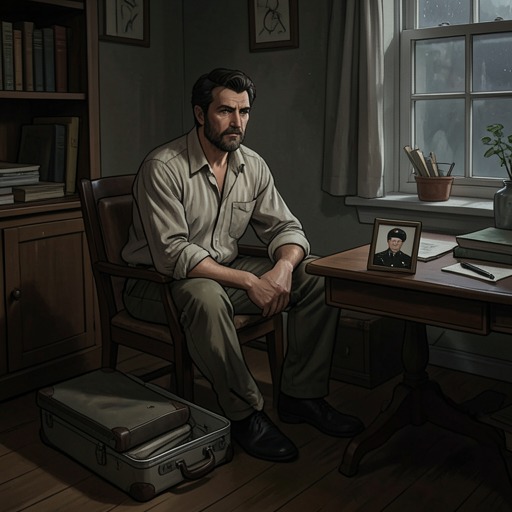
Roca lives with his children in an old farmstead standing alone against the evening light, a dark shape on an emptied plain. When four men approach in an old Mercedes, he first notices the dust rising above the corn and then hears the engine. Cars are rare in the area, and he understands that the arrival is not ordinary. He watches the Mercedes disappear behind a line of oaks, then turns away rather than continuing to observe it.
The vehicle’s apparent departure does not reassure him. At a stream junction, the men avoid the road to the farm and continue toward Alvarez, as though pretending to leave. Roca recognizes the deception. When his son returns carrying one rifle and another under his arm, Roca tells him to put them down there. He then turns to Nina, touches her head, and urges her to come to him without fear. Before that, he has placed a key on the table, gestured to his son, and instructed Nina to get up. The scene establishes him as a father trying to direct his children through an imminent danger, but it leaves the precise purpose of the key and the children’s instructions unstated.
Salinas’s Accusation
In a later confrontation, Salinas tells Roca that he wants him. Roca answers that the war is over, but Salinas rejects that separation between past and present. He describes himself as a wartime codebreaker who worked at a desk, mocked by his opponents as Salinas the Rat, and insists that he fired a gun only twice during four years of war. His account turns on the second shot: at the end of the war, he killed his brother in a hospital.
Salinas describes finding that hospital filled with patients who had been tortured and left in extreme suffering. His brother, barely able to breathe, first begged Salinas and then asked to be killed. Salinas says he could not at first bring himself to act; another man in the chapel was suffocating a patient with a pillow, and Salinas watched him close the patient’s eyes. When soldiers were reported to be coming, Salinas tried to suffocate his brother, stopped, and then took a pistol and shot him in the forehead. He tells Roca that this was his second wartime shot and that he intends to fire one more time.
Roca cries out that he had nothing to do with it. Salinas identifies the hospital as Roca’s and accuses him of being the doctor who treated the patients and helped destroy them. Roca protests and questions the claim, but the supplied account establishes Salinas’s accusation, not an independent confirmation of Roca’s precise role. Salinas then presses a pistol against one of Roca’s knees and shoots. Roca falls backward, curls on the ground, and screams as Salinas stands over him and threatens to kill him. The injury makes the confrontation physically immediate, while Roca’s denial leaves the accusation unresolved in the scene.
Nina and the Secret of the Trapdoor
Roca’s later confession centers on a particular act: one evening, he opened a trapdoor and then closed it again. He believes Nina will not forget what he did. From that day, he says, he began waiting for her, certain that nothing could prevent her eventual arrival. He expects her to come herself, look him in the face, and speak to him; he does not imagine being killed from behind or having an unknown person sent in his place. His expectation makes the past an ongoing encounter rather than a finished episode.
Roca describes carrying the secret all his life like an illness and says he deserves to be sitting there with her. The confession links his present, face-to-face meeting with Nina to the concealed act at the farm. The evidence does not specify exactly what his opening and closing of the trapdoor meant for her in that moment; what it does make clear is that Roca regards the act as a lasting betrayal or failure for which Nina may hold him to account. His waiting, and his insistence that she will speak to him before anything else, show how thoroughly that anticipated reckoning has organized his sense of the years since.
Violence, Ideology, and Responsibility
Roca also articulates a political justification for wartime violence. He argues that suffering had to be endured and inflicted to make a better world, and that the struggle required destroying much of what existed. In his account, once the need to fight was accepted, distinctions between old and young, friend and enemy ceased to matter. He frames the cost in terms of a promised reward: a decent life, happiness, and the ability of millions to live and die with dignity rather than be trampled or mocked. He even asks what the death of one child, or ten or a hundred, could mean against that larger aim.
That argument places Roca’s ideals beside the intimate consequences he cannot leave behind. The language of a world built through necessary suffering offers a collective rationale for harm; the trapdoor confession, by contrast, narrows the reckoning to a single action and a particular person who may remember it. Salinas’s accusation likewise makes Roca answer for violence inflicted on identifiable patients, though Roca’s responsibility remains contested in the confrontation. Across these episodes, Roca is presented not simply as a target of wartime vengeance but as someone caught between denying a charge, defending a political logic of sacrifice, and acknowledging a secret he has carried for a lifetime.